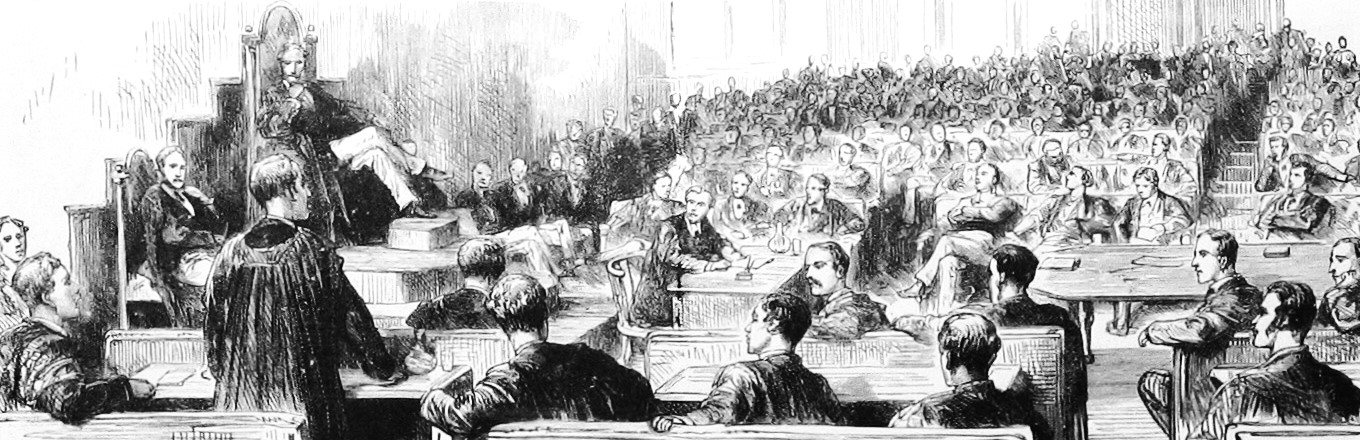
A Debate at the Union Club, Public Domain
Introduction to Oxford-Style Debating Format
Speeches are often prepared in advance
Opening Remarks: Often 07:00 to 10:00 Minutes
Floor Speech: About 01:00 Minutes
Closing Remarks: No Specified Limit (Contextual)
Roles Present in the Room
- Chairperson: A chairperson presides over the debate and moderates audience participation. Always be respectful to the chairperson and it is common courtesy to refer to them as "Honourable Chairperson".
- Debaters: This is you (hopefully). Your job is to debate for the motion you have prepared for and give it your best job. Remember, a debate is just a debate. Doing your best is more than enough. A win is just a bonus.
- Observers: Observers are non-participating members in a debate. They may choose to speak for a small period during the Floor Speeches. However, their greatest duty is to vote at the end of the debate to choose a winner.
Debate Structure and Explanation
- Opening Vote: Some modern adaptations will feature an initial vote to see the audience's opinion before the debate has begun. This will be used to measure the greatest gain in popularity by the end of the debate.
- Opening Remarks*: This section features alternating speeches between the two teams where they produce their case whilst rebutting the other side. There is no clear cut structure to these speeches, and rhetoric wit and oratory skills tend to resonate better with the audience. The first speakers of each side will also introduce the speakers of the other team as well. Opening remarks should balance advocacy for your own case with critique of the opponent.
- Floor Speeches*: At this stage, the Chairperson may invite several members of the audience presenting their opinion and/or arguments in a limited amount of time (around a minute). These speeches may be curated to produce a range of opinions. These speeches are non-competitive and are used to encourage audience engagement.
- Panel Discussion: Some modern adaptations may allow speakers to directly engage with each other. This may be used as a podium to clarify your case as well as attack specific aspects of the other case. Some organisers may opt to moderate this in form of a talk-show. This is a grand opportunity for teams to engage thoroughly with their opponents.
- Questions and Answer Session: Many adaptations opt for a QnA Session in addition to the POIs raised by the audience. This would allow the audience to raise questions that have emerged throughout the debate. These questions may be targeted as pleased and seek to clarify or challenge. This would be the final opportunity for the audience to engage with the debaters.
- Closing Vote*: This is the final stage where the audience members will vote on which team to win. Traditional versions may involve members physically walking through the "Aye" and "Noe" doors. However, modern adaptations would use raised hands or digital voting.
How to Win
Teams will be judged based on how persuasive they are. It is often not encouraged to be highly technical as they will be judged by a general audience. This also means that the oratory skills of the debaters play a larger role in their performance. Often presentation takes more weighting than pure theory. It would be beneficial for members to practice on their public speaking skills and technical speaking skills.
Some tactics used to win-over the audience include humour, sarcasm, and even backhanded compliments towards the opponent team. Remember that using these are only competitive tactics and may not reflect their personal attitude towards you. However, it is also important for you to remain respectful when using these methods. Although, personal advice is to avoid it as a common tactic. It is equally easy to win and lose a crowd when overusing these methods as you may dilute your case, make a fool out of yourself, lose your crowd, be misunderstood... etc, etc.
Adjudication Outcome
The audience holds the sole adjudication power and the winner is chosen by popular vote. The exact process may vary by debate. However, we can often generalise it as follows: Majority vote wins in a debate with only a closing vote. Greatest voter gain wins in a debate with both an opening and closing debate.