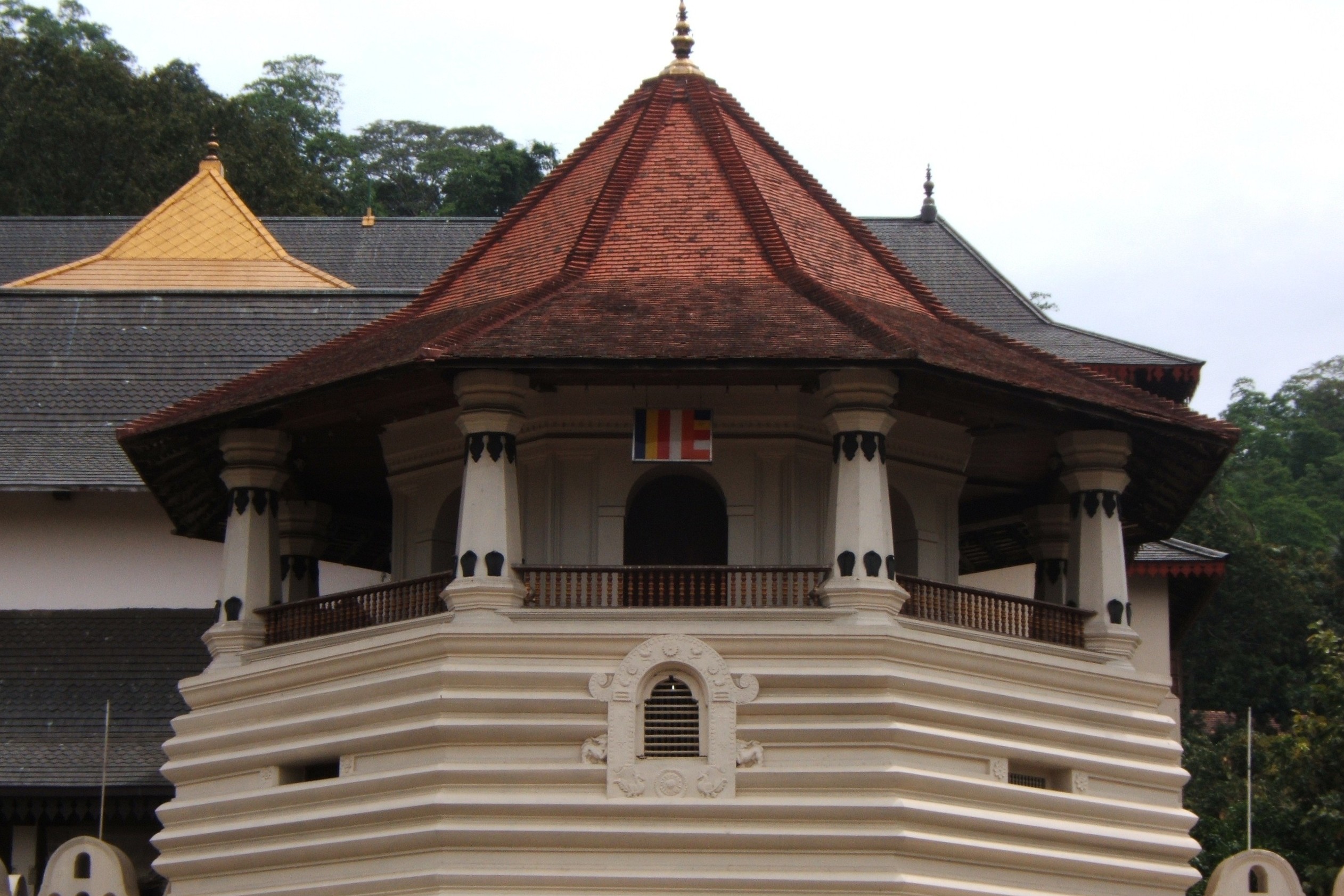
By MediaJet - Own work, CC BY-SA 3.0, Link
Implications of Buddhism on Political Systems in Sri Lanka
19 August, 2025 | Originally an A-Level EPQ Submission
Buddhism, the state religion of Sri Lanka, has remained entangled in all lives and institutions of Sri Lanka. Historically, royal patronage and religious loyalty have elevated Buddhism to a state of authority. This report examines existing literature, including public opinion, to explore implications of Buddhism on political thought, governance, and authority figures in Sri Lanka. Main findings characterise Buddhist clergy and institutions to be embedded in the Sri Lankan political landscape. They act as informal political advisory bodies, influencing state governance often overruling electoral mandates. Furthermore, Buddhist Nationalist rhetoric significantly shapes public opinion, potentially even causing extremist behaviour. Buddhist symbolism and monastic endorsement also shape electoral support, which is both highly sought after by political leaders and detrimental for non-Buddhist politicians. The uneven power Buddhist figures hold in Sri Lankan politics suggests challenging and hostile social structures towards non-Sinhala-Buddhists. These institutions often propagate messages that are not representative of traditional Buddhist teachings, suggesting that the authority vested in Buddhist figures due to their Buddhist affiliation is misused in Sri Lanka.
Research Methodology
The research methodology for this paper was developed using the Research "Onion'' Model [1] It involves choosing a data collection/ analysis method, a time horizon, strategy/ies, methodology, approach to developed theory, and the philosophy [1] as a framework. Data for this research will be collected mainly through secondary research. This decision was primarily motivated by the difficulty in approaching a large enough sample population for primary data because there is little access to a large enough Sri Lankan population in the accessible vicinity. Furthermore, it has been understood that a significant portion of the intended research material is secondary (for example, government notices, acts of Parliament, news articles) and cannot be replicated via primary research.
Owing to the intended evolutionary nature of my research, I would implement a longitudinal study where data will be collected repeatedly over time. However, the research areas will be restricted to ensure that there will not be an overwhelming amount of research to analyse. Although eliminating bias would be challenging, I will add extra care to these decisions to minimise the impact of any potential bias.
As the nature of my research demands, the research strategy much resembles a case study approach where I would focus on Sri Lanka. The case study delves into the religious and political makeup of the state while ensuring focus on specific themes (such as extremism, discrimination, political endorsement, and influence on legislature) and entities (such as Bodu Bala Sena and the Temple of the Tooth Relic).
As the implications of Buddhism discussed involve research into specific observations that lead to a final general conclusion, inductive reasoning is applied to the project. I chose an inductive approach as the initial research revealed that the implications of Buddhism are multi-faceted, and applying a deductive approach was more likely to introduce bias, which would ultimately hinder the quality of my final conclusions. Therefore, considering both the context of my project and my expectations of the final outcome, I have decided on an inductive research approach.
Since my exploration aims at comparing and contrasting Buddhist principles on governance and their actual implementations, critical realism would be a suitable research philosophy to adhere to. Critical Realism is an ontological (philosophical study of being and existence) philosophy that acknowledges the `real' world yet explores the `observable' world accessible to us. This lens would allow me to explore the observable implications of Buddhism on the case studies and the underlying sociopolitical and ethno-cultural dynamics that shape these observations. Hence, I chose critical realism as the research philosophy to effectively approach my research.
Introduction
Sri Lanka is a Sinhalese-majority South Asian nation with a predominantly Buddhist population [2]. Its extremely active political landscape has been defined by a series of significant events, including independence from the British Empire (1948), the transition to a republic (1972), and continued political turbulence. Sri Lanka has experienced two failed Marxist uprisings (1971, 1987), a 26-year civil war (1983-2009), anti-Muslim riots (2014, 2018), and terrorist bombings (2019). The mass protests of 2022 led to the resignation of the government, and in 2024, a Communist party-led coalition was elected to the presidency and a parliamentary majority. Amidst this political activity, Buddhism retains a definitive role in Sri Lankan governance. This report critically examines existing literature to explore how varying interpretations of Buddhism shape political thought, governance, and authority figures in Sri Lanka. Through analysis of historical and contemporary influences, it aims to highlight the complex relationship between Buddhism and Sri Lankan politics. Additionally, this report aims to bridge the lack of academic research by Sinhalese authors on this subject, examining how selective interpretations of Buddhism have shaped both public perception and Sri Lanka's political landscape.
Buddhist Literature on Governance
The Sri Lankan Ministry of Education mandates religious education from Grades (Years) One to Eleven, highlighting its importance. This is an example that demonstrates the symbiosis between Buddhist rationale and government-backed school of thought in Sri Lanka. For Buddhist students, who form a majority of the student population, this ensues eleven years of study of Buddhism in various contexts and lenses: Sinhala Buddhist Literature, National Unity, and even Principles of Governance. I will use the chapters "Raja Bawathu Dammiko'' [3] from the Year 9 textbook, and "Buddhist Teachings About State Governance'' [4] from the Year 10 textbook, as a structure for this exploration.
Ten Royal Virtues
Dasa-Raja Dharma, or Ten Royal Virtues, are a set of qualities that are prescribed to be held by righteous and just kings. These qualities continue to be used as a standard to uphold the image of a "perfect'' ruler. Particularly in the Birth Stories, royal characters (often a previous birth of the Buddha) demonstrate these virtues to overcome the challenge of the story, examples being the Tale of Nandimiyaga [2] and the Tale of Tesakuna [3]. This has not only added to the prestige of these standards, but also has deemed them meritorious acts. The virtues are namely [3]:
- Danam (Charity)
- Silam (Morality)
- Parichchagam (Generosity)
- Ajjavam (Honesty)
- Maddavam (Gentleness)
- Tapam (Self-control)
- Akkodam (Non-anger)
- Avihinsancha (Non-violence)
- Kantheechcha (Patience)
- Avirodanam (Uprightness)
These virtues, owing to both their preaching and the belief of implementation by the Buddha himself, hold significant weight in defining the ideal nature of a ruler. These principles are historically said to have been adhered to by some rulers in many different Buddhist kingdoms, and remain even today, undisputed as a set of reasonable guidelines.
Seven Conditions of Welfare
Saptha Aparihaniya Dharma, or the Seven Conditions of Welfare, is a set of principles that the Buddha is said to have introduced to the Vajji Republic [4], a contemporary aristocratic republic. Their political and sovereign success has been attributed, at least in Sri Lankan belief, to these seven conditions they religiously observed within their governing practices. These conditions are [4]:
- Convening regularly
- Convening, discussing, and dispersing peacefully
- Refraining from imposing previously not imposed (unfair) laws and protecting existing laws
- Respecting Elders and their opinions
- Protecting women
- Protecting religious sites and observing practices without fail
- Caring for venerable guests of the kingdom
Similar to the Royal Virtues, these principles are undoubtedly reasonable advice to be followed by a governing body or ruler, albeit with a hint of religious and cultural beliefs. According to the tales, following these conditions has secured great prosperity to the republic, and the beliefs can be attested by historic records. The textbook, too, actively highlights these qualities as ones of a healthy governing system/ body and encourages students to adopt them into their beliefs.
Implementation in Sri Lanka
Interestingly, these guidelines seem to have influenced political figures to highlight their "Buddhist'' identity although their actions may sometimes diverge from it. For instance, many Sri Lankan politicians employ charity as part of their publicity campaigns [5] and pay significantly more attention to Buddhist monks and other elders who participate in rallies. A famous quote to illustrate the latter is "ape hamuduruwane'' (transl: "Dear Venerable (monk)''), the address used by Mahinda Rajapaksa, a former president, in many of his rallies [6], further adding on to his image as being "gentle'' and "moral''. Furthermore, political figures often engage in acts deemed meritorious, particularly during election campaigns [5], as both a bonding ritual with the population and a display of one's faith.
However, despite these attempts, successful and not, to appear more "Buddhist'', there are many instances public knowledge that demonstrate these politicians acting otherwise. We can employ Vasudeva Nanayakkara as an example of how politicians may contrast with the principles of "self-control", "non-anger", and "gentleness". He is almost comically known for his explicit exclamation "pakaya'' [7] during a Parliamentary proceeding, towards another parliamentarian. These characters continue to shape the image of Sri Lankan politicians whose actions may diverge significantly from Buddhist principles. Additionally, some of the particular thematic beliefs are specifically significant as they paint an even more diverse yet disturbing picture of the Sri Lankan Buddhist identity. This will be discussed further under our exploration of Political Thought. Likewise, instances of brawls within the Parliament [8], even escalating to physical violence, continue to show that whilst authority figures in Sri Lanka deliberately acknowledge and attempt these principles, their actions are sometimes perceived and understood to be false. Overall, while Buddhism teaches many positive principles that are even included in the country's school syllabus, political authority figures are often seen to selectively draw on these to only strengthen their public image. At other times, their actions contradict these principles at the expense of the original message, facilitating the emergence of diverging schools of thought that may not represent the traditional interpretations.
Buddhist Influence on Political Thought
As a state which not only legally recognises Buddhism as the state religion, but also holds a majority Buddhist population whose patriotism is bound to the religion, Sri Lanka is an example of how religious messages may be interpreted differently within political landscapes. Through this exploration, I intend to understand how Buddhism, in its diverse interpreted forms, shapes the political thought of the citizens of the country. As I have shown above, despite inclusion in education, political authority figures continue to act in unfavourable manners, questioning whether the population, too, missed the point.
The ethno-national identity of Sri Lankan Buddhists manifests itself within legislature, even extending to state recognition and favouritism towards the religion. An introductory viewpoint on the relationship between Buddhism and the Sri Lankan state can be illustrated using Article 9 of the Sri Lankan Constitution [9]:
The Republic of Sri Lanka shall give to Buddhism the foremost place and accordingly it shall be the duty of the State to protect and foster the Buddha Sasana, while assuring to all religions the rights granted by Articles 10 and 14(1)(e)
The Sri Lankan state institutionally prioritises Buddhism and actively fosters it. Whilst similar (and more extreme) declarations of favour towards a religion can be found globally, it is interesting to explore Sri Lanka through understanding this information. This is because not only does this declaration hold valuable context, but also this article is used as a reason for much of the Buddhist political thought in Sri Lanka. For example, a 2003 Supreme Court interpretation of Article 9 ruled that "the state is constitutionally required to protect only Buddhism, and other religions do not have the same right to state protection" [10] [11] which appears to also be a stance adopted by certain groups justifying the need for state prioritisation of Buddhism in Sri Lanka.
The large overlap between the majority Sinhalese and Buddhist populations was used to kindle the spirit of Sri Lanka's independence movement, and has later evolved into a combined identity of the "Sinhala-Buddhist" [4], deepening the religious divide into an ethno-religious one. This combined identity, characterised with self-praise and xenophobia, highlights the complex political use of Buddhist teachings. Furthermore, this identity is sometimes linked to ethno-religious extremism within specific political ideologies of Sri Lanka. Although a minority within the belief systems of Sri Lanka, they maintain a sizeable impact in their actions. Although Buddhism traditionally teaches to tolerate and coexist with other faiths, some interpret this in ways that lead to discrimination of said faiths as seen within some extremist groups (such as Bodu Bala Sena).
Principles of Coexistence
Before delving into exploring how differing interpretations manifest within these groups and figures, it is important that we understand what stance Buddhist teachings hold and how they are traditionally interpreted. The Karaneeya Metta Sutra (Discourse on Loving-Compassion) discusses the Buddhist concept of "Loving-Compassion," [5] an interesting lens to explore these characters seen in extremist tones. Furthermore, I would explore another lesson from the Buddhism Year 10 syllabus to highlight and discuss how Sri Lankan society is taught to interpret these teachings.
The lesson Apekama saha Sahajeewanaya (transl: `Our-ness' and Coexistence) introduces the following phrases (translated) [4] that are said to be advice from the Buddha:
Togetherness is virtuous [...] Reconcile; do not debate
This advice of social unity primarily stems from the general theme of non-violence; however, the social connotations of this message can be interpreted to extend to one of coexistence. This idea continues to be seen in the Discourse on Loving-Compassion where the Buddha is said to have preached [12]:
Let no one deceive another
or despise anyone anywhere,
or through anger or resistance-perception
wish for another to suffer.
This advice can be interpreted to advocate for social unity more directly. As the textbook chapter mentioned above presents (translated), "the Buddha does not approve of approaching others with hatred and unhappiness due to reasons such as religion, race, and caste" [4]. These ideas comprise the interpretation that is generally accepted and taught in Sri Lanka.
Bodu Bala Sena
In contrast, the Bodu Bala Sena (Buddhist Power Army, or BBS) is an ultranationalist Buddhist-supremacist organisation who claims its vision to be the "Protection of Buddhism for Future Generations" [13]. This builds onto the "majority-with-minority-complex" perception on the BBS, highlighted by their consistent claims and support for claims such as "non-Buddhists are invading cities" [14] or the existence of a "conspiracy to cause the extinction of the Sinhala race" [15]. Though lacking substantiated evidence, the BBS has amassed a sizeable following that actively believes and endorses these claims. These beliefs have, on multiple occasions, led to controversial group activities and further claims that continue the tension within the Sri Lankan community [6].
There have been instances where prominent Buddhist clergy have publicly disowned the views expressed by the BBS. An example of this is Prof. Bellanwila Wimalaratana Thero who has publicly stated that the "views of the Bodu Bala Sena are not the views of the entire Sangha community" [16]. This trend of disowning the beliefs extends to politics as well. Notably, this has led to the BBS being denounced by notable representatives of almost all the political parties. However, the most interesting aspect is public opinion. Public opinion on the BBS is split, polarised, and passionate where some support the nationalist views of the BBS and others denounce its divergence from traditional interpretations of Buddhism. This duality illustrates the influence of extremist Buddhist figures on public opinion. Examples include: [17]:
Can you hear the Sinhala sound, you Muslim (derogatory) dogs? [...] Your Allah has not once been on this land, you outsiders (derogatory) (translated)
Galaboda [sic] seems to be an animal. He can never be a human being.
The exploration into the BBS has allowed us to see how their views differ from traditional Buddhist beliefs. Their continued sizeable support, despite being a minority, has not only been accused of multiple attacks on ethnic-minority groups [17][18], but also acts as a catalyst to explore how varying interpretations of Buddhist teachings affect the political thought of different groups.
Controversial Buddhist Figures
Within these varying schools of thought on Buddhist governance, many individual monks have attracted controversy around their views and actions as well. Exploring some of these figures and their views would allow me to illustrate how Buddhist authority figures shape and reshape political thought in Sri Lanka. However, an important prerequisite is understanding that some of these controversial figures do not align with the traditional interpretations of Buddhism mentioned above.
Battaramulle Seelarathana thero exemplifies the controversy surrounding clergy in Sri Lankan politics. As a recurring candidate in Sri Lanka's Presidential Elections, he has characterised that "it has always been a monk that saved the country" (translated) and that a "layman ruler can never care for the country more than a monk" (translated) [19]. However, he also claims that "you cannot fix a country with religion" (translated) [19] questioning the legitimacy of his political aims. The controversy around Seelarathana extends into his racist remarks, involvement in politics, and the often unorthodox presence. In multiple public interviews, he has expressed views against minority groups. He claims that Muslim and Tamil political parties are racist [19] , that rulers favour the Muslim population [20], and calls for Sinhala people to protest against some Muslim politicians [20]. These views illustrate a continued majority with a minority complex within some Buddhist figures. His favourable policy towards the recreational use of Cannabis, both illegal [21] and considered sinful [7] has attracted controversy and public ridicule. These factors erode both his political aims and the broader legitimacy of clergy in politics due to misalignment between his policies and traditional Buddhist teachings and resulting public ridicule for his statements.
Whilst Seelarathana's controversy mainly stemmed from his eccentric demeanour and political aspirations, Galagodatthe Gnanasara thero's controversy stems from his radical ethno-nationalist rhetoric. In a rally, often blamed for inciting the 2014 anti-Muslim riots, Gnanasara addresses a roaring and cheering crowd. He says that they "still have a Sinhala Police, a Sinhala Army" [17] and threatens that if "even one Muslim (derogatory) or another outsider (derogatory) lays a hand on a Sinhalese [...] it will be the end of them all" [17]. Such rhetoric exemplifies how Buddhist figures can diverge from traditional Buddhist teachings and yet be met with social approval. Gnanasara openly affirmed, "yes, we are racist," [17] illustrating the overt ethno-religious rhetoric invoked in some nationalist Buddhist movements. Despite this, it is clear that Gnanasara and similar personalities hold not only a sizeable public following but also complicity from the ruling factions. The latter is illustrated better by the Presidential Pardon granted to him by President Sirisena when he was arrested for contempt of court [22]. This continues to show that controversial Buddhist figures experience a range in public reception yet hold influence over public sentiment.
Overall, we can see that diverging Buddhist schools of thought continue to interpret and adopt the Buddhist identity via ethnic and legal lenses. Whilst this is perceived and accepted by the population in varying ways, some who adopt extremist interpretations and identity can be associated more with protesting and violent political thought. These cases exemplify the evolving role of Buddhist clergy in Sri Lankan political thought, where they simultaneously command public support while diverging from traditional Buddhist teachings. This trend raises important questions about how religious authority and political power shape national policies.
Buddhist Influence on State Governance
Since ancient times, the Buddhist Sangha has advised rulers and influenced state governance. This trend continues to the present where Buddhist clergy remain influential in the country's governance, particularly the Maha Sangha (Great Clergy) who are senior clergy from the major orders of Sri Lanka. This further illustrates the reverence of Buddhist authority figures within advisory roles for state governance.
Whilst they are not officially appointed, they are often consulted and informed of state decisions, further highlighting the power they hold. Through this exploration, I aim to understand how Buddhist authority figures, especially of varying schools of thought, influence state affairs and decisions of the government. These political roles influence political thought, state governance, and beyond. Additionally, these figures often advocate for certain policies and engage in protests themselves.
Consultative Role
The Mahasangha, a community of monks representing monastic lineages of Sri Lanka, continues to serve as an advisory body. Collectively and severally, political figures often consult and heed the advice of this loosely defined group [23] [24]. Despite their informal authority, members of the Maha Sangha frequently hold advisory roles within the government. By exploring the Maha Sangha's involvement in state affairs, public statements, and official appointments, I aim to illustrate the nature of their consultative role.
However, these appointments are not without controversy. The Maha Sangha faces criticism for its involvement in politics and their divisive rhetoric. For instance, Vendaruwe Upali thero, Deputy Chief Incumbent of the Asgiri Chapter [8], advised President Gotabaya Rajapaksa to "be a Hitler and build the country if they call [him] a Hitler" (translated) and suggested that military rule may be necessary to "fix the country" (translated) [25]. Public reaction to this is deeply polarised, with some expressing passionate support and others strong criticism [25] [26]:
[This] is indeed very ominous for the future of minorities and political dissidents in Sri Lanka.
[...] the thero said that the leader of a country must be patriotic, love the nation, love the people, love the religion, uphold the traditions, customs of Sri Lanka.
These reactions illustrate the divided public opinion regarding the Maha Sangha’s role in politics. This reflects broader tensions in Sri Lanka’s religious-political discourse. Upali's opinion reflects Seelarathana's view of “you cannot fix a country with religion” as "a Hitler" is not a metaphor indicative of "a leadership bound with Buddhism" [25]. Overall, such controversy highlights the differences between traditional Buddhist teachings and the political advice of the Maha Sangha suggesting varying beliefs.
Beyond informal advice, the Maha Sangha is also offered direct government appointment. In 2022, President Gotabaya Rajapaksa appointed a Presidential Task Force (PTF) for the "implementation of the concept; one country, one law" [27], in reference to the mixture of Roman-Dutch Law, English Common Law, and three customary legal systems [9] within Sri Lankan law. Galagodatthe Gnanasara thero, introduced earlier, was appointed chairman of this PTF [27]. Whilst the contents of the final report of the task force are unavailable for public access [28], the principle behind its inception and appointment of Gnanasara has invited further polarised discourse among the public [29]. Despite controversy, figures like Gnanasara continue to receive government appointments, reinforcing the Maha Sangha's enduring institutional legitimacy in Sri Lankan governance.
Military Advocacy and History
The first of the Five Precepts prohibits killing [10]. Yet, historical and modern events, such as the Battle of Vijithapura and the Sri Lankan Civil War, demonstrate how military action has been justified to protect Buddhism. Interpretations vary; while some support strict non-violence, others justify military action under specific justifications. For instance, the Sri Lankan defence of Japan [11] during the 1952 San Francisco Treaty Conference, quoted below, exemplifies an emphasis on ahimsa, non-violence:
...we believe in the words of the Great Teacher (the Buddha) [...] that `hatred ceases not by hatred but by love'.
Buddhist influence on war varies between traditional interpretations and mytho-historical portrayals, particularly the Mahavansa. Mahavansa tales are frequently invoked in political rhetoric to justify military action as a means to protect Buddhism, reinforcing the Sinhala-Buddhist identity. Examples include tales of the Buddha "[striking] terror to [non-Buddhist demons'] hearts" suggesting that even the Buddha sanctioned the use of terror towards non-Buddhists [30].
The Battle of Vijithapura was a historic battle between Sinhalese king Dutugamunu and Tamil king Ellalan. The primary motive of this war was to allow Dutugamunu "to establish the doctrine of the [Buddha]" [30]. The Mahavansa also praises Ellalan, that he ruled with "even justice toward friend and foe," and once begged to be executed for injuring a Buddhist place of worship. [30]. Ironically, in the aftermath of the war, an Arhat reassures Dutugamunu that he is free of sin as those he slaughtered were "not more to be esteemed than beasts" [30]. This narrative frames military action as religious duty for the protection of Buddhism, and frames non-Buddhists as demonic.
The Mahavansa's depiction of all of Dutugamunu's enemies as "Damilas" [12] almost characterising Tamil people as an enemy of the Sinhalese [30]. has been referenced in modern nationalistic sentiment, reinforcing narratives that justified ethnic tensions during the Sri Lankan Civil War. Field Marshal Sarath Fonseka, a military commander during the war, reinforces these parallels by claiming that the Sri Lankan Army "repeated King Dutugamunu’s feats at Vijithapura" [31]. Thus, whilst traditional interpretations advocate non-violence, the Mahavansa shapes nationalistic interpretations, influencing modern and historic political decisions. This demonstrates how Buddhist narratives, particularly the Mahavansa, remain political instruments, legitimising state actions even when contradicting traditional Buddhist principles.
Buddhist Protest
Extending beyond military engagement, Buddhist authority figures have shaped protest in modern-day Sri Lanka. Driven by the strong Buddhist involvement during Sri Lanka's independence movement, Buddhist figures continue to engage in protest to express discontent, sometimes violently. A historical example is Wariyapola Sri Sumangala thero who is known for taking down the Union Jack and hoisting the Sinhalese flag just before control of the Kandyan Kingdom was ceded to the British Crown. Such acts of rebellion have informed and facilitated the modern forms of protest among Buddhist figures.
While many protests are symbolic, some have taken extreme paths, including acts of violence. A notable example of this is the assassination of S. W. R. D. Bandaranaike [13], then Prime Minister of Ceylon, by Talduwe Somarama Thero. Somarama's confession [14] and criminal investigations led to conspiracy charges on Mapitigama Buddharakkitha Thero among six others [32]. Both monks were convicted; Somarama was executed by hanging and Buddharakkitha was imprisoned for life [15]. Further in Somarama's confession, he says that Buddharakkitha said "that Bandaranaike had to be killed in order to save the country, race and religion" [32]. This illustrates both the depth of political concern among Buddhists and the involvement of Buddhist clergy within it. Despite the Buddhist prohibition on killing, some Buddhist figures have justified violence for nationalistic aims.
A modern, less-violent example is some factions of the Aragalaya (transl. Struggle) protest series targeted against the government. Owing to the decentralised political efforts of the series, a homogenous belief was not apparent beyond the primary aim. This led to Buddhist beliefs to emerge once more in protests. Koswatte Mahanama Thero, a protester in Aragalaya, is an example who opposes the government as "[the rulers] don’t live by the precepts of Buddhism" [33] citing corruption. Whilst concerns of divisive sentiment have been raised [34], the principle of Buddhist clergy assuming a "guardian role to protect the people of Sri Lanka" [35] has been reaffirmed. The subsequent success of the protest series, whilst not fully credited to Buddhist forces, highlights their growing active involvement in Sri Lankan protest.
These examples demonstrate the continued evolution of Buddhist protest from a persistent political force to even include forms of violent extremism. Buddhist figures continue to shape and reshape the political landscape of Sri Lanka. Beyond their official and unofficial influence, these figures actively pursue political aims via protest. This increasingly dominant force is often remembered for its adverse effects, and continues to incite deep divisions in public sentiment. This analysis illustrates how Buddhism remains strongly interwoven with Sri Lankan state governance, legitimising its policies and protest. Whilst some advocate traditional principles, others use militarism and nationalism, exemplifying their role in state governance.
Buddhist Influence on Authority Figures
Beyond directly political roles, Buddhist figures indirectly shape Sri Lankan authority through endorsement and constructing legitimacy via Buddhist affiliation and symbolism. The reverence attached to these figures, reinforced by their influence over the Sinhala-Buddhist majority, ensures that this influence remains crucial within Sri Lanka's evolving political landscape.
Endorsing Authority Figures
The relic of the tooth of the Buddha has historically been used as a source of divine legitimacy to rule Sri Lanka. Since its acquisition by the Sinhalese Monarchy, close patronage of the relic led it to be enshrined as a royal symbol. The relic has been housed and rehoused near the royal palace for the entirety of its future until its current housing in the Royal Palace Complex of the Kandyan Kingdom. Whilst colonial rule disrupted its direct role in legitimising sovereignty, its role has evolved as a source of blessing for incumbent leaders. This is illustrated by the traditional visits to the Temple of the Tooth by newly elected/ appointed authority figures, such as Presidents [36] [37][38]. While not legally mandated, this is an important public bonding ritual to signify political legitimacy to Buddhist voters.
Since independence from the British Crown in 1948, every executive leader has been Buddhist (by birth or converted) [39], illustrating a de facto political exclusivity, reinforced by Buddhist monastic endorsements and Sinhala-majority voter preferences. Whilst minority candidates have occasionally succeeded in local elections, the absence of non-Buddhist executive leaders illustrates systemic barriers to minority representation, raising questions about political inclusivity. Their limited electability suggests restrictive voter preferences, limiting electoral demographics, and Buddhist-nationalist rhetoric. This exclusivity is reinforced as political parties rarely nominate non-Buddhist candidates for executive roles, and many minority candidates apply independently.
During the 2024 Presidential Elections, Buddhist institutions, including Chief Incumbent of the Mihintale Raja Maha Vihara [40] and the National Bhikkhu Front [41], publicly endorsed prominent candidates such as Anura Dissanayake and Sajith Premadasa. These endorsements took the form of temple events, televised statements by senior monks, and campaign appearances [41][42], reinforcing their appeal among Sinhala-Buddhist voters. As illustrated earlier, these incentivise political figures to explicitly incorporate traditional Buddhist virtues into their campaign identities. Furthermore, this religious exclusivity shapes the Sri Lankan populist rhetoric exemplified by controversial religious figures such as Gnanasara thero and Seelarathana thero [19] [20] [17] as well as political figures such as Sajith Premadasa [43], deepening religious polarity.
Despite Sri Lanka's multi-religious society, non-Buddhist presidential candidates face unfair political competition, increasing systemic disadvantages to their electability. The 2024 elections saw only five candidates of minority background—three Tamil, two Muslim—out of thirty-nine candidates, who collectively only secured 1.87% of the national vote [44]. While historic regional voting patterns indicate stronger support for Tamil and Muslim candidates in the Northern and Eastern provinces, national electoral politics remain heavily dominated by Sinhala-Buddhist candidates, discouraging non-Buddhist political participation at higher levels [16].
The intersection of legitimacy, monastic endorsement and the nationalist rhetoric of politicians continues to influence Sri Lankan political competition. This religiously driven electoral exclusivity significantly reduces non-Buddhist candidates' electability compared to their Sinhalese counterparts and diminishes their influence, affecting political inclusivity, minority representation, and the democratic landscape of Sri Lanka. While Buddhism remains a cultural influence, its relevance in state politics raises concern about Sri Lanka's future pluralistic governance. Whilst some political movements advocate for inclusivity, the Buddhist identity embedded in electoral politics suggests significant barriers against minority candidates at the national level with an ambiguous image of the future.
Relationship with Authority Figures
Many newly elected executives take office amid the chanting of Jaya Mangala Gatha, seeking divine blessing for a new term. Beyond such symbolism, the relationship of political figures and Buddhist figures can elevate or condemn authority figures. As discussed earlier, they maintain a powerful consultative and protest-driven role in Sri Lankan politics.
Given the Sangha's immense influence, many politicians seek their support and approval. In some instances, authority figures appease the Sangha, even at the expense of their electoral promises. Maithripala Sirisena, former President, sought modernising constitutional reforms but interestingly faced unanimous opposition from the Mahanayaka theros [45]. Despite public support for reform [17], Buddhist clergy overruled the proposal, highlighting their authority over executive decisions. It is striking that Buddhist clergy, traditionally viewed as embodying loving-compassion, opposed legislation aimed to foster communal harmony [46], illustrating the Sangha's continued political divergence from traditional teachings. Sirisena's quick submission [47] highlights how politicians adjust political aims and policy to secure Buddhist approval. These cases highlight how authority figures prioritise Buddhist approval over voter preferences and broader social coexistence.
Whilst many politicians support Buddhist institutions, others have opposed some of its actions. Former Finance Minister, Mangala Samaraweera, is an example of such opposition. He openly criticised Warakagoda Gnanaratha thero who claimed that Muslims do not love Sinhala-Buddhists and suggested that such "traitors" should be "stoned to death" (translated) [48]. Samaraweera responded by urging Buddhists to reject the "Talibanization" of the religion and denounced "robed orders" promoting violence [49]. While these remarks gained him praise from minority communities [50], they also led to his exclusion in public events [51] and branding as anti-Sinhala-Buddhist. His political life illustrates how opposing the views of the Sangha will marginalise authority figures. The fusion of Buddhism and monastic authority grants Buddhist figures unofficial immunity from criticism, discouraging opposition. This suggests a perception that to challenge clergy is to challenge Buddhism itself, which continues to shape the Sri Lankan political landscape.
Overall, many political authority figures maintain a careful relationship with Buddhism at the risk of marginalisation if otherwise. The perceived equivalence between Buddhism and Buddhist clergy reinforces the costly repercussions of opposition, facilitating the Sangha to express and endorse views freely. The need to appease the Sinhala-Buddhist majority, who hold the Sangha as both advisors and community leaders, forces authority figures to coddle Buddhist institutions for political stability.
Conclusion
Despite diverse interpretations, there is a clear understanding and access to traditional Buddhist teachings in Sri Lanka. These interpretations often manifest themselves in mythology, ethno-nationalism, and forms of protest. Though both forms influence political thought, governance, and authority figures, extremist interpretations tend to resonate more strongly with segments of the population. These circumstances often create a hostile environment for religious and ethnic minorities in Sri Lanka. Furthermore, traditional teachings are often sidelined in favour of political expediency, undermining social coexistence. Authority figures maintain a range of opinions on Buddhist rhetoric, even as they often invoke or benefit from it. Ultimately, modern Buddhist rhetoric remains deeply interwoven with Sri Lankan politics, influencing its path in both subtle and overt ways. This suggests that modern political implications of Buddhism significantly deviate from traditional teachings, raising concern about certain Buddhist figures misusing Buddhist symbols, institutions, and authority.
Endnotes
[1]^ This is a model designed to support develop a research methodology
[2]^ This is a story of a deer king, said to be a past birth of the Buddha, who convinces the (human) king of Kosala to provide security to all creatures of the jungle
[3]^ This is a tale of a parrot, said to be a past life of the Buddha, who is adopted and later becomes heir to the throne of Kosala. However, he is said to have rejected the throne, written down his advice for rule, and left to the forests
[4]^ This idea was popularised by Anagarika Dharmapala, a key figure in Sri Lanka's independence. His ideas perpetuated the belief that Buddhism was under siege by non-Buddhists, and that they sought the extinction of the Sinhala-Buddhist, deepening the religious divide into an ethno-religious one
[5]^ The discourse advises to love "enlightened ones, ones not enlightened, and any other being–long, massive, medium-sized, short, delicate, visible, invisible, near-residing, far-residing, born, and yet to be born" (translated)
[6]^ They are accused of fuelling the 2014 anti-Muslim riots
[7]^ It violates the Fifth precept, "I shall abstain from all intoxicants"
[8]^ This is one of the two most influential Buddhist chapters of the country. They are a monastic lineage
[9]^ These are Kandyan Law, customary Muslim Law, and Tesavalamai (customary Tamil Law)
[10]^ "I shall abstain from killing"
[11]^ Sri Lanka is a notable defender of Japanese freedom during the conference
[12]^ This translates to "Tamil"
[13]^ He was shot at his residence where he routinely allowed citizens to meet him and later succumbed to his wounds
[14]^ This was later retracted
[15]^ The sentence was later reduced to 20 years
[16]^ Many minority political parties often choose to endorse Sinhala-Buddhist candidates who share similar views or make political promises
[17]^ Sirisena's political manifesto promised a new constitution as part of his presidential campaign
Bibliography
[1]^ M. Saunders, P. Lewis, and A. Thornhill, Research methods for business students. Pearson Education, 2007.
[2]^ Department of Census and Statistics, Ministry of Finance and Planning, Sri Lanka, Population Atlas of Sri Lanka 2012. 2012.
[3]^ Ven. Kotaneluwe Punyananda, Ven. Urugamuwe Assaji, Ven. Diyagama Narada, U. Mallikarachchi, R. A. Gunewardena, and R. M. T. T. Rathnayaka, බුද්ධ ධර්මය: 9 ශ්රේණිය [Buddhism: Grade 9]. Educational Publications Department-Sri Lanka, 2020.
[4]^ Y. P. P. Kavisigamuwa, W. A. C. Weragoda, U. Mallikarachchi, and R. A. Gunewardana, බුද්ධ ධර්මය: 10 ශ්රේණිය [Buddhism: Grade 10]. Educational Publications Department-Sri Lanka, 2020.
[5]^ Sajith Premadasa, “අද රටේ ජාතික ආරක්ෂාව වෙනුවට තිබෙන්නේ ජන සමාජයේ අනාරක්ෂිතභාවයයි. [Today We Have Social Insecurity Instead of National Security].” https://www.youtube.com. Accessed Mar. 08, 2025 [Online] Available: https://www.youtube.com/watch?v=MBZF7KwSQPw.
[6]^ S. Jayasinghe, “Joining The Mangala Controversy: The Clergy Should Get Off The Backs Of Sri Lankans,” Colombo Telegraph, 2019. Accessed Mar. 08, 2025 [Online] Available: https://www.colombotelegraph.com/index.php/joining-the-mangala-controversy-the-clergy-should-get-off-the-backs-of-sri-lankans/.
[7]^ ChaKra TV, “Vasudeva Nanayakkara || vasudeva nanayakkara (pakaya).” https://youtube.com. Accessed Jan. 15, 2025 [Online] Available: https://www.youtube.com/watch?v=yA-61QEN2vU.
[8]^ M. Safi and A. Perera, “Sri lanka MPs fight in parliament as power struggle deepens.” https://theguardian.com. Accessed Jan. 16, 2025 [Online] Available: https://www.theguardian.com/world/2018/nov/15/shameful-day-sri-lanka-mps-fight-in-parliament-as-power-struggle-deepens.
[9]^ Sri Lankan Government, The Constitution of the Democratic Socialist Republic of Sri Lanka. Parliament Secretariat, Sri Lanka.
[10]^ 2023 Report on International Religious Freedom. US Department of State, 2023. Accessed Feb. 03, 2025 [Online] Available: https://www.state.gov/reports/2023-report-on-international-religious-freedom/sri-lanka/.
[11]^ Country Policy and Information Note: Sri Lanka – Religious Minorities. UK Visas and Immigration, 2021. Accessed Feb. 03, 2025 [Online] Available: https://www.ecoi.net/en/file/local/2059375/Sri_Lanka−_Religious_M inorities_ − _CP IN _ − _v2.0_ − _August_2021.pdf .
[12]^ Ven. Thanissaro trans., “Khp 9. Karanīya Mettā Sutta — Goodwill.” https://www.dhammatalks.org/. Accessed Jan. 27, 2025 [Online] Available: https://www.dhammatalks.org/suttas/KN/Khp/khp9.html.
[13]^ Bodu Bala Sena. https://www.bodubalasena.org/. Archived Sept. 22, 2023 [Online] from Original Accessed Jan. 29, 2025 [Online] Available: https://web.archive.org/web/20230922215224/https://www.bodubalasena.org/.
[14]^ Bodu Bala Sena, ““අන්යාගමිකයන් නගර ආක්රමණය කරනවා, සිංහල බෞද්ධයන්ට කැලෑ වදින්න වෙලා…” අස්ගිරි මහනාහිමියෝ කියති... [“Non-Buddhists are Invading Cities, Sinhala Buddhists are Forced to Take to the Woods” Asgiri Chief Incumbent Says].” https://www.bodubalasena.org/. Archived Feb. 04, 2013 [Online] from Original Accessed Jan. 30, 2025 [Online] Available: https://web.archive.org/web/20130204021104/http://bodubalasena.org:80/sinhala/2012/11/අන්යාගමිකයන්- නගර-ආක්/.
[15]^ Bodu Bala Sena, සිංහල ජාතිය වඳ කිරීමේ කුමන්ත්රණය බොදු බල සේනා හෙළි කරයි... [Bodu Bala Sena Reveals Conspiracy to Eradicate Sinhala Race...].” https://www.bodubalasena.org/. Archived Feb. 01, 2013 [Online] from Original Accessed Jan. 30, 2025 [Online] Available: https://web.archive.org/web/20130201110948/http://bodubalasena.org:80/sinhala/2012/11/සිංහල-ජාතිය-වඳ-කිරීමේ-කුම/.
[16]^ “BBS does not represent entire Sangha.” https://www.ft.lk/. Accessed Feb. 03, 2025 [Online] Available: https://www.ft.lk/front-page/bbs-does-not-represent-entire-sangha/44-140311.
[17]^ Colombo Telegraph, “Bodu Bala Sena Meeting - Aluthgama.” https://www.youtube.com. Accessed Feb. 05, 2025 [Online] Available: https://www.youtube.com/watch?v=iOxPJzlXDJs Comments retrieved from YouTube comment section on Feb. 24, 2025.
[18]^ SADISI TV, “බොදු බල සේනාවෙන් හදිසි වැටලීමක් Bodu Bala Sena raids Muslim Clerics and a Buddhist Monk.” https://www.youtube.com. Accessed Feb. 05, 2025 [Online] Available: https://www.youtube.com/watch?v=LFSgzuNyBCA Comments retrieved from YouTube comment section on Feb. 24, 2025.
[19]^ Ada Derana, “"ධර්මයෙන් කවදාවත් රටක් හදන්න බෑ.." [“You Can Never Fix a Country with Religion”]| Baththaramulle Seelarathana himi | SRI LANKA DECIDES | Ep 08.” https://www.youtube.com. Accessed Feb. 23, 2025 [Online] Available: https://www.youtube.com/watch?v=Smeqd34bu48.
[20]^ Sera Tv සැර Tv, “"ඒ කියන්නේ ඔබවහන්සේ ස්පා යනවා.." බත්තරමුල්ල සීලරතන හිමිගේ අන්දෝලනාත්මක ප්රකාශය [“It Means Your Venerable Visits Spas (Brothels)..? Baththaramulla Seelarathana Thero’s Controversial Statement”] - seelarathana himi.” https://www.youtube.com. Accessed Feb. 23, 2025 [Online] Available: https://www.youtube.com/watch?v=Ampo-YDhPCs.
[21]^ Sri Lankan Government, The Poisons, Opium and Dangerous Drugs Ordinance of 1935. Parliament Secretariat, Sri Lanka.
[22]^ M. Rasooldeen, “Jailed hardline Buddhist monk granted pardon in Sri Lanka,” Arab News, 2019.
[23]^ Colombo Telegraph, “President Sirisena Swears To Abide By Maha Sangha Dictates,” Colombo Telegraph, 2016. Accessed Feb. 23, 2025 [Online] Available: https://www.colombotelegraph.com/index.php/president-sirisena-swears-to-abide-by-maha-sangha-dictates/.
[24]^ “Wickremesinghe says guidance of Sinhala Buddhist monks ’crucial’ for Sri Lanka ,” Tamil Guardian, 2024. Accessed Feb. 23, 2025 [Online] Available: https://www.tamilguardian.com/content/wickremesinghe-says-guidance-sinhala-buddhist-monks-crucial-sri-lanka.
[25]^ Ada Derana, “Gotabaya Rajapaksa attends religious observances on his 69th birthday.” https://www.youtube.com. Accessed Feb. 23, 2025 [Online] Available: https://www.youtube.com/watch?v=LwSBo0NX34c Comments retrieved from YouTube comment section on Feb. 24, 2025.
[26]^ Colombo Telegraph, “‘If They Call You A Hitler, Then Be A Hitler And Build This Country,’ Asgiriya Anunayaka Thero Tells Gotabaya,” Colombo Telegraph, 2018. Accessed Feb. 23, 2025 [Online] Available: https://www.colombotelegraph.com/index.php/if-they-call-you-a-hitler-then-be-a-hitler-and-build-this-country-asgiriya-anunayaka-thero-tells-gotabaya/ Comments retrieved from YouTube comment section on Feb. 24, 2025.
[27]^ The Gazette of the Democratic Socialist Republic of Sri Lanka Extraordinary (2251/30). Department of Government Printing, Government of Sri Lanka, 2021.
[28]^ S. R. Mohan, “Rs 4.3M spent on ‘One Country-One Law’ Task Force,” Ceylon Today, 2022. Accessed Feb. 23, 2025 [Online] Available: https://ceylontoday.lk/2022/10/15/rs-4-3m-spent-on-one-country-one-law-task-force/.
[29]^ C. P. Samarawickrama, “Ven. Gnanasara Thera to head Presidential Task Force for “One Country, One Law” concept,” Daily Mirror, 2021. Archived May. 06, 2023 [Online] from Original. Accessed Feb. 23, 2025 [Online] Available: https://web.archive.org/web/20230506184741/https://www.dailymirror.lk/top_story/Ven-Gnanasara-Thera-to-head-Presidential-Task-Force-for-One-Country-One-Law-concept/155-223378
[30]^ Ven. Mahanama, W. Geiger trans., and M. H. Bode trans., The Mahāvaṃsa or the Great Chronicle of Ceylon. Information Department, Ceylon Government, 1912. ch. I, XXI, XXV, XXXII. Accessed Feb. 16, 2025 [Online] Available: https://lakdiva.org.lk/mahavamsa/.
[31]^ T. R. Perera, “Tigers in INGO clothing,” The Nation, 2009. Archived Oct. 02, 2009 [Online] from Original Accessed Feb. 20, 2025 [Online] Available: https://web.archive.org/web/20091002065343/http://www.nation.lk/2009/06/28/militarym.htm.
[32]^ D. B. S. Jeyaraj, “Aftermath Of Bandaranaike’s Assassination: INVESTIGATION TO INDICTMENT,” Daily Mirror, 2019. Accessed Feb. 24, 2025 [Online] Available: https://www.dailymirror.lk/opinion/Aftermath-Of-Bandaranaikes-Assassination-INVESTIGATION-TO- INDICTMENT/172-175319.
[33]^ L. Subramanian, “How Aragalaya is helping heal wounds of Sri Lanka’s civil war,” The Week, 2022. Accessed Feb. 26, 2025 [Online] Available: https://www.theweek.in/theweek/more/2022/07/30/how- aragalaya-is-helping-heal-wounds-of-sri-lankas-civil-war.html.
[34]^ D. Senaratne, “Beyond the Slogans: How the ‘Aragalaya’ was characterised by Sinhala Buddhist Nationalism,” South Asia @ LSE, 2023. Accessed Feb. 25, 2025 [Online] Available: https://blogs.lse.ac.uk/southasia/2023/08/14/beyond-the-slogans-how-the-aragalaya-was-characterised-by-sinhala-buddhist-nationalism/.
[35]^ H. B. Dassanayake and R. Gamage, “Post-Aragalaya shifts in the politics of the Buddhist Sangha,” Daily FT, 2024. Accessed Feb. 25, 2025 [Online] Available: https://www.ft.lk/columns/Post-Aragalaya-shifts-in-the-politics-of-the-Buddhist-Sangha/4-757240.
[36]^ “Hon President visited the Temple of the Tooth,” Sri Dalada Maligawa, 2020. Accessed Mar. 08, 2025 [Online] Available: https://sridaladamaligawa.lk/hon-president-visited-the-temple-of-the-tooth-2/.
[37]^ “8th Executive President of Sri Lanka Visited the Temple of the Sacred Tooth Relic today,” Sri Dalada Maligawa, 2022. Accessed Mar. 08, 2025 [Online] Available: https://sridaladamaligawa.lk/8th-executive-president-of-sri-lanka-visited-the-temple-of-the-sacred-tooth-relic-today/.
[38]^ “President’s First Visit to Sri Dalada Maligawa for Blessings of the Sacred Tooth Relic,” Sri Dalada Maligawa, 2024. Accessed Mar. 08, 2025 [Online] Available: https://sridaladamaligawa.lk/ෙපරහර-සංෙද්ශය-ගරැ-ජනාධිපත/ .
[39]^ S. Jayasinghe, “Sri Lanka: Buddhism to remain paramount in new charter,” Reuters via Al Jazeera, 2017. Accessed Mar. 08, 2025 [Online] Available: https://www.aljazeera.com/news/2017/7/12/sri-lanka-buddhism-to-remain-paramount-in-new-charter.
[40]^ “Mihintale Chief Prelate offers conditional support to Sajith Premadasa,” Newswire, 2024. Accessed Mar. 08, 2025 [Online] Available: https://www.newswire.lk/2024/08/13/mihintale-chief-prelate-offers-conditional-support-to-sajith-premadasa/.
[41]^ The Life Traveller, “අනුර ජනපති කරවන ජාතික භික්ෂු පෙරමුණේ අගනුවර සමුළුව [National Bhikku Front Conference in the Capital to Make Anura President].” https://www.youtube.com. Accessed Mar. 08, 2025 [Online] Available: https://www.youtube.com/watch?v=YI8tXEXZYZg.
[42]^ Newsfirst Sri Lanka, “News1st chairman of the national sangha council announces they will endorse maithripala sirisena.” https://www.youtube.com. Accessed Mar. 08, 2025 [Online] Available: https://www.youtube.com/watch?v=sz4YnUM305M.
[43]^ N. Vaffoor, “Withdrawing Mihintale security a treacherous act – Sajith,” Ceylon Today, 2023. Accessed Mar. 08, 2025 [Online] Available: https://ceylontoday.lk/2023/02/04/withdrawing-mihintale-security-a-treacherous-act-sajith/.
[44]^ Election Commission of Sri Lanka, “Live sri lanka presidential election results 2024 | real-time results.” https://results.elections.gov.lk. Accessed Mar. 08, 2025 [Online] Available: https://results.elections.gov.lk/pre2024/.
[45]^ J. Jayasinghe and C. Uduwawala, “No need of new constitutions or Amendments: Mahanayaka Theras,” Daily Mirror, 2017. Accessed Mar. 08, 2025 [Online] Available: https://www.dailymirror.lk/breaking-news/No-need-of-new-constitutions-or-Amendments-Mahanayaka-Theras/108-132149.
[46]^ “Sri Lanka begins process of writing new constitution,” Deustche Welle, 2016. Accessed Mar. 08, 2025 [Online] Available: https://www.dw.com/en/sri-lanka-begins-process-of-writing-new-constitution-to- prevent-war/a-18968845. 14
[47]^ P. K. Balachandran, “Sri Lankan constitution making process hits a serious snag,” The New Indian Express, 2017. Accessed Mar. 08, 2025 [Online] Available: https://www.newindianexpress.com/world/2017/Jan/03/sri-lankan-constitution-making-process-hits-a-serious-snag-1555613.html.
[48]^ LANKA FILES, “Sri lanka: Buddhist prelate invites sinhalese to join anti muslim hate campaign.” https://www.youtube.com. Accessed Mar. 08, 2025 [Online] Available: https://www.youtube.com/watch?v=P7AVLSm2IA.
[49]^ Mangala Samaraweera [@MangalaLK], “True Buddhists must unite NOW against the Talibanization of our great philosophy of peace love of all beings. No Buddhist can condone a statement to stone another human being to death, even if it emanates from the robed orders. lka.” X (Formerly Twitter). Jun. 19, 2019 Accessed Mar. 08, 2025 [Online] Available: https://x.com/MangalaLK/status/1141189084984987650.
[50]^ M. Harees, “Mangala Samaraweera – A Legend Of Humanity An Icon Of Peaceful Co-Existence, Is No More!,” Colombo Telegraph, 2021. Accessed Mar. 08, 2025 [Online] Available: https://www.colombotelegraph.com/index.php/mangala-samaraweera-a-legend-of-humanity-an-icon-of-peaceful-co-existence-is-no-more/.
[51]^ “Racism has become a commodity today - Dambara Amila Thero,” Ada Derana, 2019. Accessed Mar. 08, 2025 [Online] Available: https://www.adaderana.lk/news.php?nid=55287.